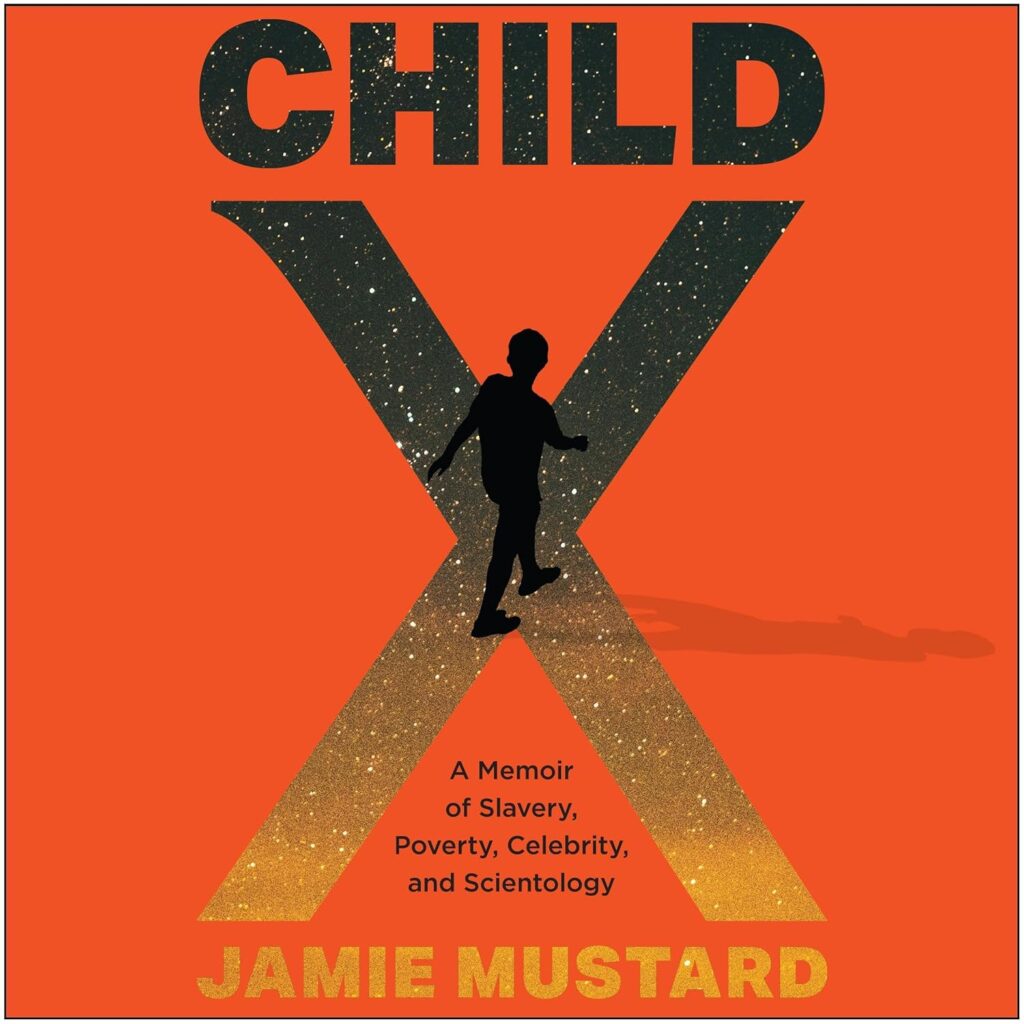
More about retribution than redemption
At birth, Jamie Mustard’s mother abandoned him in what he calls Scientology’s ‘baby factory’ in Los Angeles. Hundreds of children around the globe suffered shameful neglect from the few ‘nannies’ tasked with their care. Mustard’s story is harrowing. I can confirm from interviews with him and others subjected to this heinous system that his account of deprivation and mistreatment is accurate.
Although his mother took him away from ‘the movement’ (as he calls Scientology), he chose to return at age 15 to fulfil his billion-year contract in Scientology’s sailor-suited Sea Organization. He collected millions of dollars selling the group’s highest level of hypnotic inductions (the subject of my own recent If Scientology Ruled the World) before escaping at age 19.
Mustard says that he was ‘illiterate in every way but could read.’ This is properly ‘agraphia’ – the inability to write – rather than ‘illiteracy.’ With his remarkable grandma’s support, Mustard overcame his agraphia and graduated from the celebrated London School of Economics. Unfortunately, his book literally demonizes escapees from Scientology who did not share the misfortune of being born into the group:
‘today it is the former members who built the movement … who are killing us … Their denial while pretending to be our allies crushes our minds. They are devils.’
Although he points out that Scientology uses Maoist brainwashing techniques, he says that recruits ‘chose’ to join. Mustard also insists that no one has spoken out about the abuse of children in Scientology, though in 2023 he assured me he’d read my 1990 book Let’s Sell These People a Piece of Blue Sky, which is not the only place where I have documented such abuse. Sadly, he makes no case to expose the current Scientology operation and fails to even mention the current 4000 Sea Organization slaves, let alone the 40 million slaves accounted by the UN in the contemporary world.
The twist in this tale is that Jamie Mustard actually returned to Scientology after receiving his university degree. In a Scientology directory for 2004 – ten years after his supposed escape – Mustard listed his art gallery as a ‘Scientology Enterprise,’ where he employed fellow Scientologists and tithed to the cult. No mention is made of this in Child X.
The book has a litany of factual errors, for instance placing Charlemagne in 634 AD (in the wrong century) and giving an exact date for a Saxon raid (1558 years before his birth), marching in close formation. They are called the Dark Ages because there are very few records. He says that the town of East Grinstead is a ‘small hamlet’ (confusing it with Hubbard’s Saint Hill) and that its name derives from ‘the place where one shows one’s teeth’ rather than the widely documented ‘green place.’ Such information perhaps derives from the Scientology belief that imagination is reality. He believes that his ‘past life memory’ is accurate. This raises doubts about his credibility.
This book has an agenda. It is a call to action by those born in the cult against those tricked into joining it (and subjected to systematic thought reform). It should be read with caution. Mustard is economical with the truth and careless of facts. This book is more about retribution than redemption.